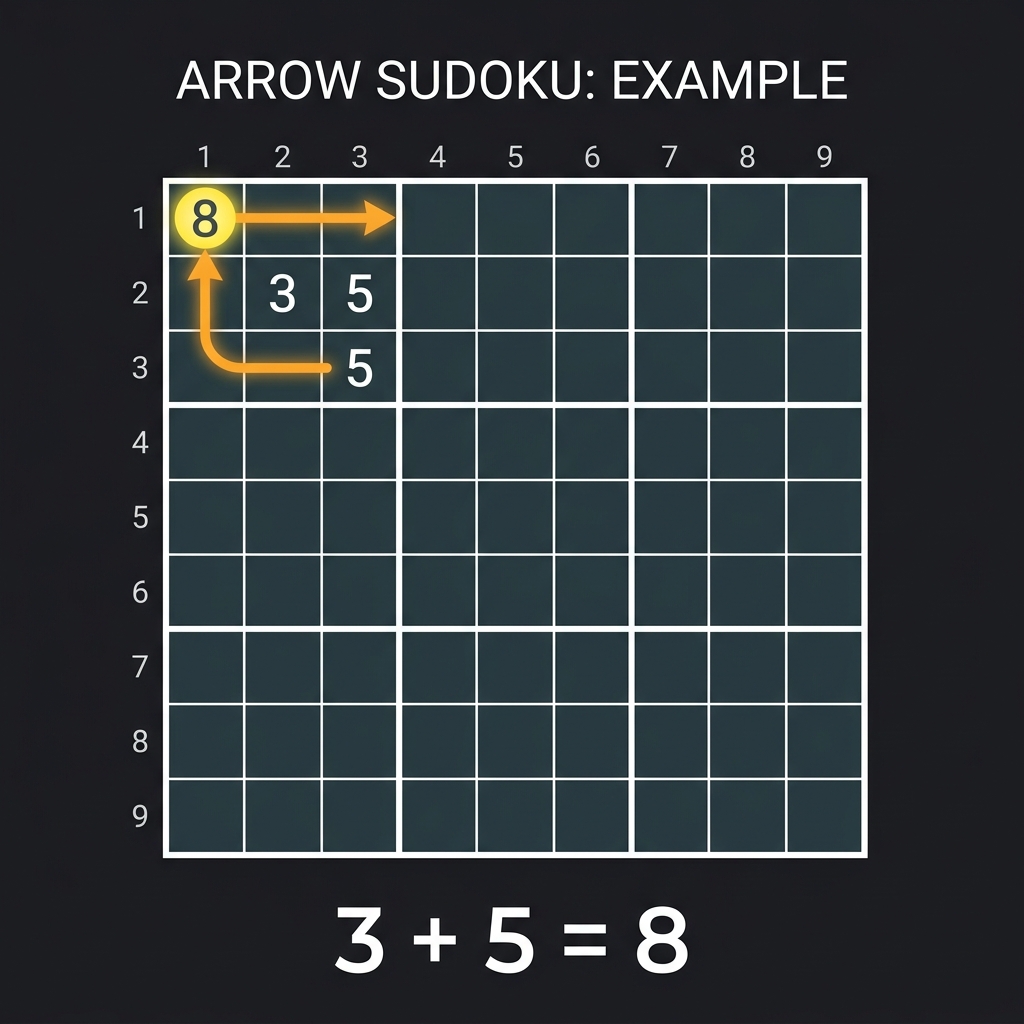
Arrow Sudoku
Paths of sums and logic.
Mastering Arrow Sudoku Variants
Arrow Sudoku is an elegant mathematical and geometrical variant where paths of arrows dictate exact arithmetic sums. It tests a solver's ability to combine spatial geometry with rapid mental addition.
1. The Core Arrow Sudoku Rule
In addition to standard Sudoku rules (digits 1-9 in every row, column, and 3×3 box):
- The grid contains large circles called bulbs with arrows extending through neighboring cells.
- The Sum Rule: The digits placed along the shaft and tip of an arrow must sum up exactly to the value placed in the bulb of that arrow.
- Repeats Along the Arrow: Digits may repeat along the shaft of an arrow, provided standard Sudoku row, column, and 3×3 box rules are not violated (e.g., if an arrow bends between two different 3×3 boxes).
2. Mathematical Constraints & The "9-Cap"
Because the bulb is a single cell, its maximum value can never exceed 9. This simple limit creates profound logical restrictions:
- 2-Cell Arrows: The minimum bulb value is
1 + 2 = 3(if cells are in the same box) or1 + 1 = 2(if cells are in different boxes). The bulb can never be 1. - 3-Cell Arrows: If all 3 cells are in the same 3×3 box, the minimum possible sum is
1 + 2 + 3 = 6. Therefore, the bulb must be 6, 7, 8, or 9! The digits 1, 2, 3, 4, and 5 are completely impossible in that bulb. - 4-Cell Arrows: In a single box,
1 + 2 + 3 + 4 = 10(which is greater than 9). Thus, a 4-cell arrow in a single box is impossible without crossing box borders!
3. High-Speed Solving Tactics
- Identify High-Demand Bulbs: Any bulb with a 3-cell arrow in the same box immediately has candidates
{6, 7, 8, 9}. Eliminate 1 through 5 right away. - Low Digits on Arrow Shafts: Cells along long arrow paths almost always contain 1, 2, or 3. High digits like 7, 8, or 9 can never exist on a multi-cell arrow.
4. Multi-Arrow Bulbs and Branching Paths
In high-level tournament compositions, setters frequently design puzzle layouts where a single circular bulb projects two or three distinct arrow paths in different directions:
- Independent Equal Sums: If Bulb B has Arrow Line 1 and Arrow Line 2 branching from it, the sum of Line 1 must equal B, AND the sum of Line 2 must equal B. Therefore, the sum of Line 1 must exactly equal the sum of Line 2!
- Symmetry Deductions: If Line 1 has two cells and Line 2 has three cells, the bulb is immediately forced to be at least 6 (the minimum sum of a 3-cell line), which simultaneously forces the 2-cell line to sum up to at least 6!
5. Box-Crossing Arrows: Utilizing Duplicates Legally
One of the most frequently misunderstood rules in Arrow Sudoku is the duplicate digit rule on arrow shafts:
- Within a single 3×3 box (or along a single row or column), digits on an arrow shaft cannot repeat because standard Sudoku rules strictly forbid duplicate numbers in the same house.
- However, if an arrow starts in Box 1, enters Box 2, and terminates in Box 5, the cells in Box 1 and Box 5 CAN contain identical digits!
- For example, an arrow shaft spanning across boxes could be
2 + 1 + 2 = 5. The two 2s are in different boxes and different rows/columns, which is 100% legal.
6. Mental Addition Drills: The Under-10 Combinations
To achieve podium-tier completion times in Arrow Sudoku, you must recognize sub-10 integer partitions without counting on your fingers:
- Sum = 7 (3 Cells): Only one combination:
{1, 2, 4}. - Sum = 8 (3 Cells): Only two combinations:
{1, 2, 5}and{1, 3, 4}. - Sum = 9 (3 Cells): Three combinations:
{1, 2, 6},{1, 3, 5}, and{2, 3, 4}.