Killer Sudoku
The ultimate hybrid of math and logic.
Mastering Killer Sudoku & The Rule of 45
Killer Sudoku (also known as Sumdoku or Samunamupure) is the most celebrated mathematical variant of Sudoku. It marries the pure deduction of standard Sudoku with arithmetic cage sums, creating a deeply satisfying solving experience.
1. The Core Killer Sudoku Rules
In addition to all standard Sudoku rules (digits 1-9 in every row, column, and 3×3 box):
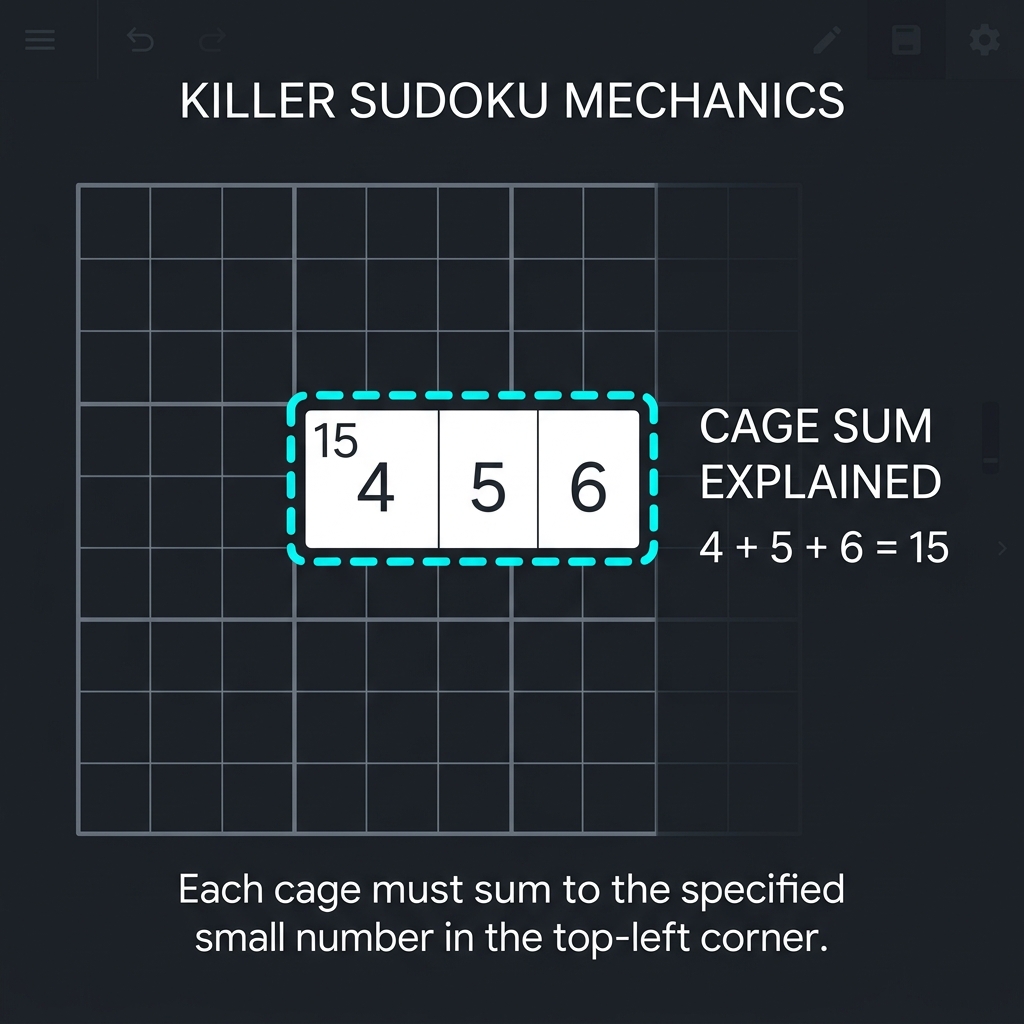
- The board features dashed boundaries called cages.
- The sum of all numbers inside a cage must equal the small number in the top-left corner.
- No duplicates: A digit can never repeat inside a single cage, even if the cage spans across multiple 3×3 blocks or rows.
2. Essential Unique Sum Combinations (The "Cheat Sheet")
Certain cage sums have only ONE possible set of digits. Memorizing these unique combinations gives you instant breakthroughs:
- 2-Cell Cages:
Sum 3={1, 2}Sum 4={1, 3}(Note:2+2is illegal due to no-repeat rule)Sum 16={7, 9}Sum 17={8, 9}
- 3-Cell Cages:
Sum 6={1, 2, 3}Sum 7={1, 2, 4}Sum 23={6, 8, 9}Sum 24={7, 8, 9}
3. The Legendary "Rule of 45" (Innie and Outie Technique)
The sum of all digits from 1 through 9 is always exactly 45 (1+2+3+4+5+6+7+8+9 = 45). Therefore, the sum of any single row, column, or 3×3 block is unconditionally 45.
The "Outie" Example: Imagine a 3×3 box where multiple cages are contained entirely within the box, except for one cage of sum 12 that has two cells inside the box and one cell sticking outside the box. If the sum of all cages fully inside the box plus the 12-cage equals 49, you know that the single "outie" cell outside the box must be 49 - 45 = 4!
4. The Multi-House Rule of 45: Solving 2-Box and 3-Box Bands
While the Rule of 45 is devastatingly powerful on a single 3×3 box or row, master Killer Sudoku solvers extend it across entire multi-box sectors:
- Two Adjacent Houses (Sum = 90): Any two complete rows, columns, or 3×3 boxes have an invariant total sum of
45 × 2 = 90. If cages spanning those two regions leave behind one or two un-caged cells, their sum is calculated effortlessly. - A Full Horizontal Tier / Chute (Sum = 135): The top three boxes (Boxes 1, 2, 3) contain 27 cells and have an aggregate sum of
45 × 3 = 135. When solving high-tier tournament Killer puzzles, summing up all cages in the top tier against 135 frequently reveals the exact value of cells protruding into the middle tier!
5. Detailed "Innie" Technique: Finding Trapped Cells
In contrast to an "Outie", an Innie occurs when all cages in a 3×3 box are contained strictly within the box boundaries, except that one cell in the box is left untouched:
- Suppose four cages inside Box 2 total: Cage A (14), Cage B (11), Cage C (8), Cage D (7).
- The sum of these four cages is
14 + 11 + 8 + 7 = 40. - Because all nine cells in Box 2 must sum up to exactly 45, the single un-caged cell (the "Innie") is mathematically compelled to be
45 - 40 = 5! - No pencil marks or candidates were needed—pure arithmetic resolved the cell instantly.
6. Extreme 4-Cell and 5-Cell Cage Combinations
In addition to small cages, high-difficulty Killer Sudokus feature large cages with restricted combinations:
- 4-Cell Sum 10: Must be
{1, 2, 3, 4}(the minimum possible 4-cell sum). - 4-Cell Sum 30: Must be
{6, 7, 8, 9}(the maximum possible 4-cell sum). - 5-Cell Sum 15: Must be
{1, 2, 3, 4, 5}. - 5-Cell Sum 35: Must be
{5, 6, 7, 8, 9}.