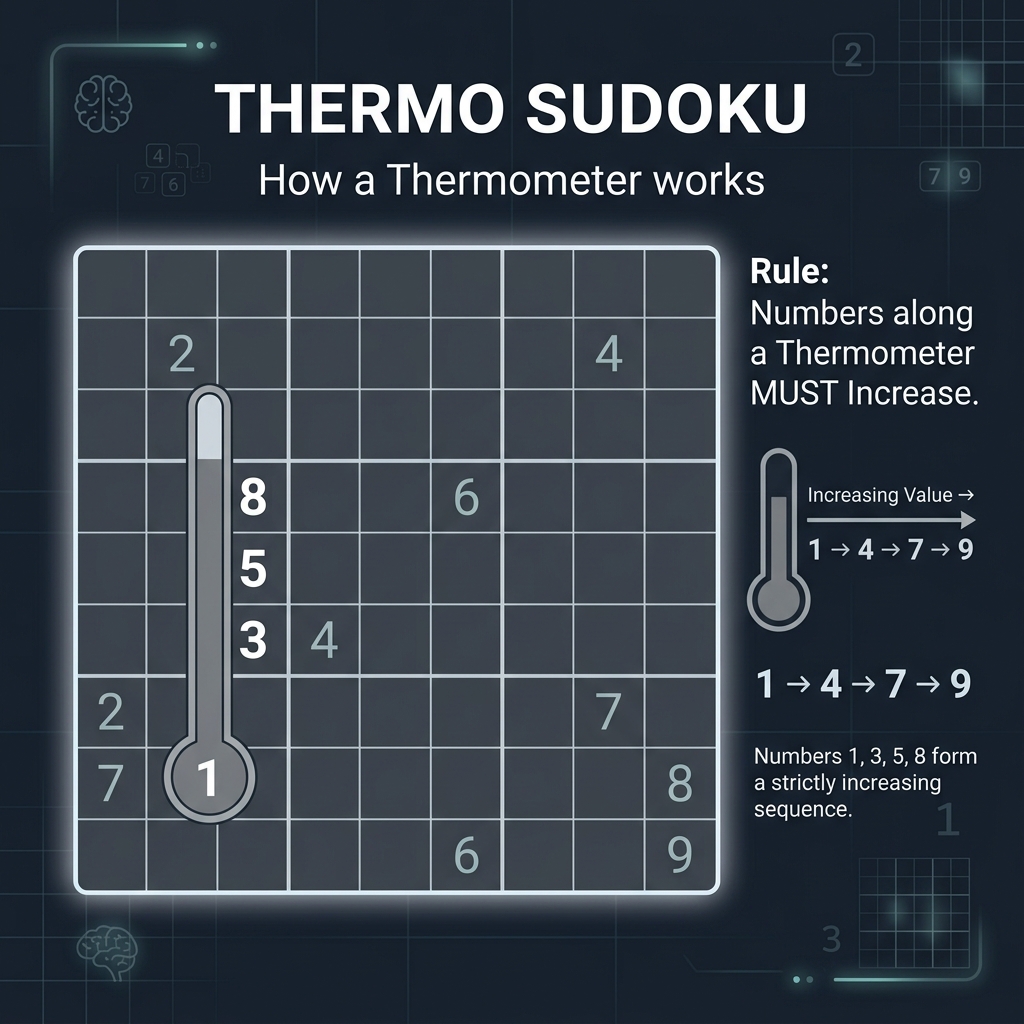
Thermo Sudoku
Enter the world of exotic variants with increasing numbers.
Mastering Thermo Sudoku Variants
Thermo Sudoku is one of the most beloved variants in competitive puzzle tournaments. It combines the classical rules of Sudoku with visual thermometers drawn across the board, providing powerful inequality constraints that allow for elegant logical deductions.
1. The Core Thermo Rule
In addition to all standard Sudoku rules (digits 1-9 in every row, column, and 3×3 box):
- Digits must strictly increase in value starting from the round circular bulb and moving along the line to the flat tip.
- Equal numbers are never permitted on the same thermometer (e.g.,
2 -> 2is illegal; it must be2 -> 3or higher). - Numbers do not need to be consecutive. A progression like
1 -> 4 -> 8 -> 9is 100% legal.
2. Mathematical Bounds: The "Length Constraint"
The length of a thermometer strictly defines the minimum and maximum numbers allowed in every single cell along its path:
- Bulb Maximums: If a thermometer is N cells long, the bulb cannot contain any number greater than
10 - N. For instance, on a 5-cell thermometer, the bulb cannot exceed10 - 5 = 5. If the bulb were 6, the remaining 4 cells would require numbers greater than 6 (7, 8, 9, and a non-existent 10!). - Tip Minimums: Similarly, the tip of an N-cell thermometer must be at least N (e.g., the tip of a 5-cell thermo must be at least 5).
- Inner Nodes: Each step along the path narrows down the legal candidate window. Cell 2 must be at least 2 and at most 6; Cell 3 must be at least 3 and at most 7; and so forth.
3. Strategic Solving Tips
- Start with Long Thermometers: Always scan for the longest thermometers on the grid first. They establish the strongest initial candidate restrictions.
- Thermometers Crossing Box Boundaries: Thermometers that cross between two or three 3×3 boxes provide cross-box elimination that quickly unlocks classical Sudoku scanning.
- Look for Intersecting Bulbs: If two thermometers share a bulb in a 3×3 box, the bulb represents the lowest digit for both branches.
4. The Pigeonhole Principle on Extreme Thermometers (6+ Cell Lines)
When a thermometer reaches 6, 7, 8, or even 9 cells in length, the mathematical pigeonhole principle virtually forces the digits with little to no ambiguity:
- A 9-Cell Thermometer: A line spanning 9 cells must contain every single digit from 1 to 9 in strictly ascending order:
1 -> 2 -> 3 -> 4 -> 5 -> 6 -> 7 -> 8 -> 9! If you encounter a 9-cell thermo, it solves itself instantly. - An 8-Cell Thermometer: The bulb is restricted to
{1, 2}, cell 2 is{2, 3}, and the tip is restricted to{8, 9}. Each cell has at most two candidate options. - A 6-Cell Thermometer: The bulb can only be
{1, 2, 3, 4}, and the tip must be{6, 7, 8, 9}. If you find a 4 placed in the bulb, all subsequent 5 cells are rigidly locked to5 -> 6 -> 7 -> 8 -> 9!
5. Thermometer Intersections & Pinch Points
Advanced tournament puzzle setters intentionally design thermometers that interact with classical row and column rules to create "pinch points":
- Shared Bulbs: If two thermometers branch out from the same bulb inside a 3×3 box, that single bulb must be lower than the second cell of *both* thermometers. If one branch is 5 cells long and the other is 4 cells long, the bulb is strictly constrained by the longer line.
- Shared Tips: When two thermometers converge toward the same tip, the tip must exceed the penultimate cell of both branches, making high numbers (8 or 9) virtually mandatory.
- Thermometers Trapped in a Single Box: A 3-cell thermometer located entirely within one 3×3 box uses up three distinct numbers that cannot repeat anywhere else in that box, generating an instant subset elimination.